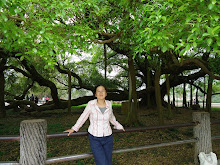
Sunday, 29 March 2009

Dali- Various sites-local scenes, people and places

DALI AND ITS MAGIC
Visiting family courtyards, cycling to around the island and lakes and local scenes of women. In traditional Naxu culture, women were the breadwinners, worked hard and carried out laborious work, from farming, setting up small buisinesses and raising children. The men socialised, partied and in the old times were also hunters. I was told by the guide that in the old times to marry a Naxi woman was an security insurance for a man. I was amazed at the amount of heavy items the women carried in the villages and mountains, in their heavy baskets they delivered on their backs branches and logs. As a woman, they had a bad deal aad I observed many who were the farm workers and carried heavy items across mountains and field.s

Below, the famous Naxi Orchesra,oldest surviving group playing music from Ming Dinasty with the majority of the male musicians in their late 70's to early eighties. It was very impressive and beautiful music. The group have performed worldwide, including UK. I made contact with the Director and if funding was raised I can arrange for them to come over in 2010 for the London Olympics. Any groups out there interested please do get in touch with me to work on possible projects.
My email is valeriechang106@hotmail.com I plan to be back in UK 12 April 2009. Tel 07941214833. I can understand why so many artists want to live in Dali, it is a beautiful place of natural beauty and retains its strong traditions and way of life.
On my return to UK, I will be seeking new opportunities for project work and employment and interested in offers.


Dali-Day 2-3 Visit to local markets and people's homes


Dali Village life-the daily market in Dali and below an old family living in the traditional style in a courtyard. Wonderful people and a slow pace of life. Something we have forgotten living in big cities.

22/3/09 Visiting local familes in Dali, gaining insight into how they live. They still retain many old traditions. Below a family courtyard. This part of the tour was fascinating and learning about Bai culture, the women still wear traditional costumes. The brighter the costumes were worn by young women and the darker clothing by older women. The families were close knit and lived in community. However, younger people were leaving the villages for the cities. Many courtyards were protected and this was wonderful to see.


Old man playing marchong at home happy and contented.
Below, the old market and women selling goods and fresh vegetables. The market was a live and very interesting.


Dali - Day 2-3

21st and 22nd March 2009 - Day 2-3 Joining the tour group
Dali- A lovly place where the Bai minority cultures live. Left, a local market where women still wear the traditional clothes.
Below, a scene from a distant and the mountains on the way to Dali village.


Dali the Old town, younger women wearing bright colour clothes and still retain the traditions of the culture.
Below, a view of the mountains near the hotel where I was staying. The area attracts many artists and musician from overseas as it has an idealic setting, with fresh air, natural beauty, nice weather all the year around and is very peaceful.


Traditional style buidlings and shops. This was the area close to where I stayed. It was fascinating and a place I could visit a gain. It was good to have a break and this would give me time to reflect on my time in China.
The diversity and vastness in China is amazing and there is so much to see and explore. It was nice to be away from the huge cities and modernisation. Dali captured for me the old life style and traditions of the minority cultures and the natural environment of China. On day 2 we explored the old villages on our bikes and Day 3 I caught the cable car to Cangsdhan Mountains.


Yunnan Travels-Day 1-2 in Kunnming-20 March 2009

Near the hotel, morning excercises for locals, he sky is clear and blue skies


A
Left, a visit to Green Lakes Park, a lovely Chinese park with local people performing chinese traditional music


A visit to the local Art Museum, heritage artefacts and collections. An interesting place giving me more historical insight in to the area.
It was good to explore the city, small compared to Chongqing and it felt more relaxing.
I was ready for my 10 day tour in Yunnance Province, I wanted to explore another region and discover the diversity of cultures. My tour trip would take me to Dali, Lijiang, Shangri-La and Zhondiang. Travelling around this province would give me another insight in to the land of minority cultures.


Wednesday, 11 March 2009

The Contemporary Art Scene in China


On Chinese Contemporary Art and the Future
Artists in their studio, the first picture is of Fanyourong is a recent graduate and she paints images of contemporary chinese women and sadness. Shen Hua, second picture is a successful artists and has held many exhibitions and many collectors and museums have bought is work. They are about local farmers and their daily lives. He feels it is important to represent them and the other China.
Third and forth picture is of Yan Shu, is a successful artists, born in China. With ref to Post Avant-Garde Chinese Contemporary Art, Four Directions of The New Era Wang Lin, art critic writes " No matter what, Yan Shu is definately not a painter that creates images. He never reproduces his own works. No matter whether he is involved in social issues or isolates himself from society, he puts his entire heart and soul in his painting. Yan Shu is able to move freely back and forth beween his private person and society; reality and dreams; paintings andwirtings; sketches adn conception, self-indulgence ad discipline. Yan Shu does as he pleases, and while this ofen surprises people, hey remain fascinated by his works". by Wang Lin

My journalists contact, Shifay based in USA who writes for Dim Sum, kindly sent me this link about the new developments and emergence of China and the arts. It is interesting to read that contemporary artist created works that related to impressions of communism and mao and their reaction to modern China.

For many years I have been actively involved with curating contemporary exhibitions for galleries, in the early late 1980's I was Visual Arts Officer for South London Gallery and in the 1990's I was Exhibitions organiser for Pitzhanger Manor Museum and Gallery. I curated one of the first group exhibition by Chinese artists based in UK, titled " Far From the Shore". I was aware in the 1990's of the work of Chinese artists and trend of movement. From mid 2007, still actively involved in the arts, I read many articles by uk press on the rags to riches artistic movement in China. The reality was the successful talented and lucky one's made millions and so did the western dealers and collectors and China was suddenly a melting pot for the most exciting art work. Who exploited who?Saatchi invested in 2000 and recently held a show from his China collection, which reflected the Post-Mao Era. The collection of work was made partly for a western audience and fulfilled many stereotypes of China.

What do I think of the trends - Young artists have had great opportunities and were picked up and exposed by the collectors and galleries. The oppression of communism before China opened up resulted in an underground arts movement that has gradually emerged and exposed the artists ideas in the west. How much of what is shown is controlled, I suspect in China artists works are carefully selected if shown in public owned government spaces. However small independent arts organisations, non government funded are more likely to have more freedom to show what they like. It is apparent from my interviews with artists that they are frustrated by Chinese society the lack of freedom to vote, the one party state and express views and frustration through their works.

It is my view, some of the younger artists may have lost their way and are responding to what the west wants to see and the economic art market. Other artists reject the trends and have the courage to paint truely what they feel. For example, the impact of people's life since the industrialisation of China and the destruction it has caused. Images that offend or challenge society and government policy etc will be barred and rejected from public spaces in China. Artists are aware they have to be careful.

Chinese arists have reached stale mate, perhaps too influenced by the economic western art market. With the global impact on art sales, this is time for them to reflect more deeply about their work, identity and culture. Its time they did more soul searching and bring out the best in their work. In future I hope that the economic downturn will bring about some new changes and trends in the art world and from China.

My next exhibition,China-UK Collaboration - I am currently researching and curating a show with 501 Contemporary Art Space with Chinese artists from UK and SW China based on a theme 'Global Migration'. I would like to use this exhibition as an opportunity for artists across to globe to create work about society, the impact on their lives and feel that the ideas they produce is independent from the Arts Market. My ambition is to create an exhibition that will be an exploration of new, exciting and fresh ideas and a cultural exchange.
If there are any interested partners who would like to collaborate with me and help sponsor this major exhibition, the exhibition will be launched late 2010 or 2011. It will tour China, Hong Kong, UK and other potential spaces subject to venues, funding and sponsors. You can email me at valeriechang106@hotmail.com if you would like more information.

Yichang Town behind my hotel area

Local scene's in Yichang, this is the old and less prosperous part of China. I was surpised to find the poor quality of housing, the air was heavily polluted and many of these people were living in very basic housing. The lucky ones were moved to the new modern government buildings down the road. I think many of the migrants were originally from the lower fields now flooded by the dam and their heart was in farming. You can see below a migrant worker, farming and working in his home made field growing vegetables. I was concerned about the pollution because the vegetables were so close to the live rail track. I even saw a train go by.
I expect the local community have no choice about their living conditions or say about the pollution. One day of breathing in the pollution was enough. I discovered on my way to the airport a massive factory and pollution was being pumped out. I hope the government in future introduces change to protect the environment that is impacting on the living conditions for all the families and people living there. I did hear form someone that the government was planning to introduce new regulation for factories to introduce filters. I feel they should act sooner to avoid serious consequences in the future as this is likely to affect people's health and the environment.


Living conditions are basic, they don't have a choice and this is when the inequalities open you up to the other side of China away from the glitz of Shanghai or Beijing.

Arriving at and near the Dams near Yichang

This is the side of China everyone should experience it was special for me.


7 March 2009 it was very peaceful and tranquil and I became more aware of the vastness of China, the diversity of people and traditions. Many migrants lost their farms and I have seen the mix of the rich and poor. In Yichang there was more poverty that brought home to me, although China is modernising, being a vast country there still exists inequalities and I will show more picture of some of the poorer quarters in Yichang.


The Chinese have a reputation for being industrious, hardworking and determination. These are qaulities I recognise in myself and this unique opportunity to participate in the Cultural Leadership programme, has given me the opportunity to reflect on my achievements and where I want to go next. The Chinese have successfully moved forward and I observe that they are a good example of being focused and striving to improve one's life. In the west we have become more complacent and I am aware that my distance from UK for this time has been a positive experience. I do miss some of my comforts from home, at the same time I have been challenged and learned so much about myself and the cultural sector. My aim will be to be a better person and in my field, I can bring a wealth of knowledge and create the relationship with China and UK promoting the new developements by artists across the globe.


Monday, 9 March 2009

Going through the locks at night and touring the Dams in Yichang


This was an amazing experience, at night we went through 4 locks, it took 4 and 1/2 hours. Many domestic boats were also locked in while the water was emptied and doors locked. To come out of the other end and view the worlds largest dam was something I had to experience for myself. It was an engineering feat. I was told that the west said it was impossible and the Chinese said it was and they proved this to the world.
The Chinese are very enterprising and hard working and this is an example, that illustrates the Chinese are capable of acheiving many things they set out to do. Like the Arts and Cultural industry, 501 and many small organisations are self reliant and do not receive government funding. It is their determination that enables them to succeed amongst all odds.


The Three Gorges Day 2


Scenic spots and a stop at Ghost City viewing the temples. The journey was a positive exprience and time for self-reflection. It was very peaceful and gave me the time to recover from my cold and reflecting on my experience of living and working in China. We were lucky with the weather as it did not rain and we had a clear day for seeing the beauty spots.
The female guide made us aware that many local inhabitants had to move from lower land once the hydro-electric power Dam was built. The existing residence at the time were relocated and compensated with brand new properties where the living conditions were better. However, the land higher was not as fertile for planting and this has led to many migrants moving to the big cities to earn a living. You see them as street sellers every where, they sell souveniers, local food and other items. The sad thing is that local residents have lost their hundreds of years of heritage and culture. The Dam has created many benefits to China as it supplies hydro-electric energy for the most of China and is an amazing sight to see.


The Three Gorge Yantze River Cruise


Weekend in March one of the most important tours to experience starting point Chongqing to Yichang. It was beautiful to be in the mountains and lakes and breath in the fresh air. I heard so much about the river and the dam that was built. I am glad that the weather held and I was on board with a group of Germans, British and Chinese.

Wednesday, 4 March 2009

4 March 2009, British Council-Visual Arts Education, Wales Week


Opening Ceremony 'Celebrating The Red Dragon, an artists exchange with China-UK in local schools in Chonqging and Cardiff. Government dignitries UK and China, at The Three Gorges Museum, organised by British Council Chongqing.
Above righ, People's Sqaure outside the Museum and right Valerie and Yan Yan at the opening.
Below, architectural entrance area of the Three Gorge Museum, spiral building.


Far right, Fine artists, Fan, Simeng and Huang-Ling all from Sichuan Fine Arts Institute.
I invited them as my guests to this special event to give them an opportunity to meet other artists and representatives from Wales.

It was a lovely morning out, we heard speeches and live welsh folk music. The event ended at the exhibition space where we all mingled, had some juice or water. I met some interesting people from Wales. I was impressed with the quality of the exhibition.

More local scenes and atmospheric smoke


Local shoe cleaner a regular scene in Chongqing


I walk up the road past the shops and towards Sichuan Fine Arts Institure and 501 Contemporary Arts Space.
Its an interesting experience. These images are everyday scenes. Today is quieter compared to the evening, when its bustling with students going to eat and shop at the night markets. Picture on the top right corner was taken at the back of the main streets, where local people live.